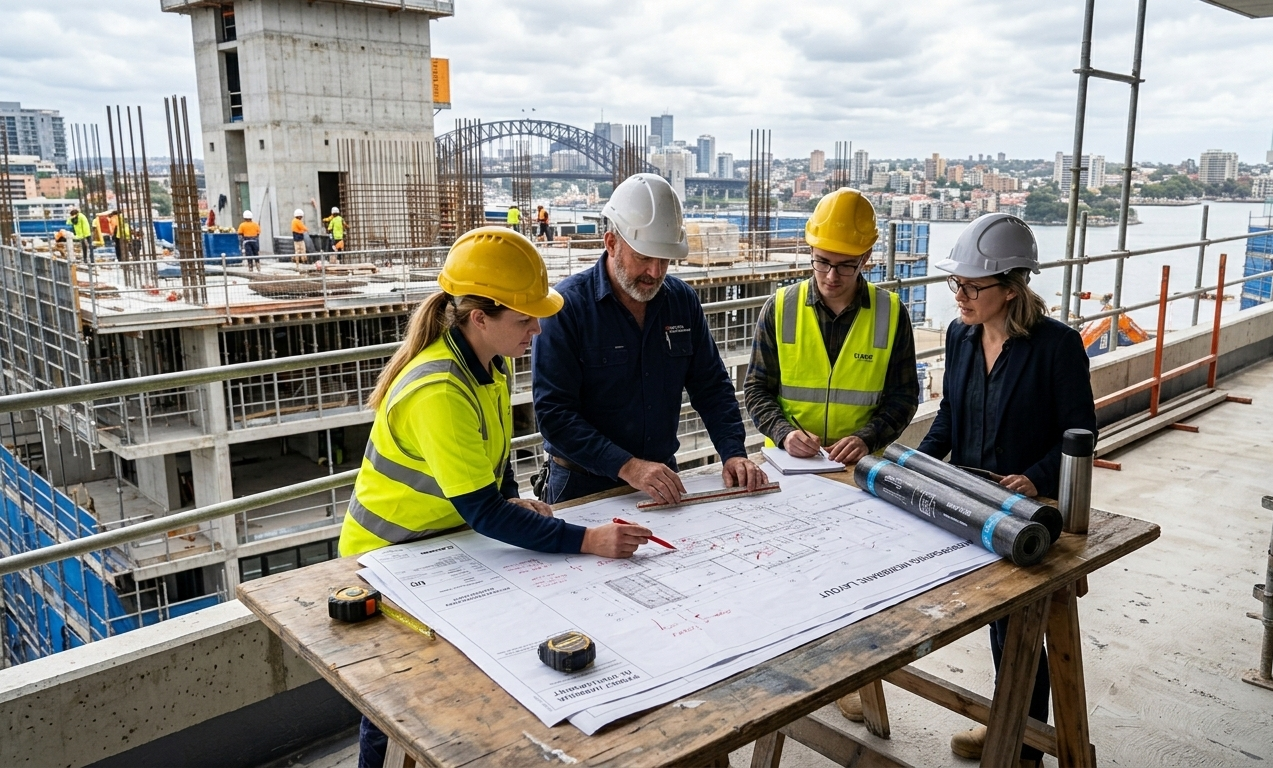
Pre-Tender vs Post-Tender: Why Waterproofing Costs Change (And How to Control It)
Why do waterproofing costs increase after tender award? Learn the key differences between pre-tender and post-tender stages in NZ and Australian commercial construction - and how to control variations.
EDUCATIONAL
Sumit Kumar
3/11/2026
Introduction
A common question across commercial construction in New Zealand and Australia:
“Why did the waterproofing package increase after contract award?”
The answer usually sits between documentation gaps and site realities.
Waterproofing doesn’t randomly become expensive.
It becomes expensive when assumptions are corrected.
The Pre-Tender Stage
At pre-tender level, estimators rely on:
Architectural drawings
Structural documentation
Generic specifications
Preliminary details
At this stage, several risks exist:
Incomplete balcony detailing
Limited penetration coordination
Undefined substrate preparation
Missing termination details
Estimators must interpret intent — not just measure drawings.
If risks are under-allowed, margin disappears later.
The Post-Tender Reality
Once the project moves forward:
Shop drawings are developed
Service penetrations are finalised
Drainage falls are adjusted
Concrete levels are surveyed
Reality replaces assumption.
This is where variations begin.
Common Causes of Cost Increases
Across NZ & AU commercial projects, the most frequent triggers include:
1. Additional Substrate Preparation
Crack injection, levelling compounds, moisture mitigation not fully allowed at tender stage.
2. Interface Clarifications
Balcony edges, cladding terminations, and door thresholds require more detailed treatment than initially priced.
3. Drainage Adjustments
Minor level changes can require complete membrane redesign.
4. Increased Testing Requirements
Flood testing or third-party inspections added post-award.
5. Specification Upgrades
Manufacturer compliance requirements clarified after contract signing.
The Pattern We See
Pre-tender pricing often focuses on visible surface area.
Post-tender adjustments focus on:
Edges
Returns
Interfaces
Preparation
Risk management
These are rarely large individually.
But across multiple levels, they accumulate significantly.
How to Control Waterproofing Cost Shifts
Cost stability improves when:
Trade scope is clearly defined before tender submission
Exclusions are documented transparently
Risk allowances are realistic
Specifications are aligned across disciplines
Measurement includes detailing — not just flat areas
Clarity at tender stage protects profit at construction stage.
The Strategic Perspective
Waterproofing should never be treated as a minor trade.
It protects:
Structure
Interior finishes
Tenant amenity
Developer liability
When documentation is vague, cost volatility follows.
When documentation is precise, margins stabilise.
Conclusion
Waterproofing costs don’t increase because contractors miscalculate.
They increase because uncertainty becomes clarity.
The more detail addressed before contract award, the less financial disruption occurs during delivery.
If your projects in New Zealand or Australia are experiencing waterproofing variations post-award, the solution often begins at the pre-tender stage.
Speak with our team about structured waterproofing cost analysis designed to reduce variation exposure and strengthen tender confidence.